From SDR to HDR: The Mathematics Behind RayNeo’s AI-Driven Visual Upscaling
A large share of streaming content arrives in SDR format. When viewed on AR glasses, this creates a gap between hardware capability and actual visual quality.
Smart glasses face a unique challenge. Unlike TVs with dedicated chips, wearable displays balance size, power, and thermal headroom (and many “display glasses” are still constrained by what they can do on-device in real time). Most AR eyewear accepts SDR input without enhancement or applies only basic tone mapping.
RayNeo Air 4 Pro introduced AI-driven SDR-to-HDR processing (often described as “AI HDR”) at CES 2026. The technology aims to convert SDR content to HDR10 in real time via its on-device processing pipeline, representing a shift in how portable displays handle video signals.
Why Most AR Content Looks Flat
Standard dynamic range video is often delivered in 8-bit color depth, meaning each color channel displays 256 brightness levels. This format was designed for displays with limited contrast, and for broad backward compatibility across devices. Legacy standards persist because creators optimize for wide device compatibility.
Modern micro-OLED screens in smart glasses can achieve very high contrast ratios. RayNeo Air 4 Pro is marketed with this specification (up to 200,000:1), but SDR content only uses a fraction of its potential dynamic range and color volume. The color space limitation compounds this for smart glasses. SDR uses Rec. 709, covering about 35% of visible colors. HDR10 content is typically signaled in Rec. 2020, expanding the container to about 75% (though many HDR masters still target DCI-P3 primaries within the Rec. 2020 container). Most smart glasses simply display the narrow gamut received without content-aware expansion.
The SDR-to-HDR Gap: A Mathematical Challenge
Converting between these formats requires more than simple stretching. The underlying math involves multiple dimensions that must transform simultaneously while preserving visual intent.
Color Space Limitations
Rec. 709 defines a triangle on the CIE color chart. HDR10’s Rec. 2020 creates a larger triangle. Upscaling means predicting what colors should appear in areas the original couldn’t represent (i.e., gamut mapping plus plausible color reconstruction).
Traditional approaches used by some smart glasses use interpolation or uniform saturation boosts, often producing oversaturated results. Sunsets shift to neon, gaming content suffers, with unrealistic skin tones. RayNeo Air 4 Pro uses content-aware color expansion rather than uniform stretching.
Dynamic Range Constraints
SDR is typically based on BT.709 with display reference behavior often aligned with BT.1886 (commonly near ~2.4 gamma, depending on setup). HDR10 uses PQ (Perceptual Quantizer) curves. These are different functions for mapping light to display values, making conversion challenging for most smart glasses.
The PQ curve maps code values nonlinearly across luminance, with perceptual uniformity that changes how precision is distributed across brightness. Converting requires context-aware processing considering surrounding brightness and content type. Bit depth expansion from 8-bit to 10-bit adds 768 additional code values overall (1024 vs 256), effectively increasing gradation resolution. Smart glasses with AI upscaling predict missing values from context rather than simple interpolation (often paired with dithering/temporal smoothing to reduce banding).
How AI Bridges the Conversion Gap
Machine learning approaches this problem differently than traditional algorithms. Rather than applying fixed rules, neural networks learn patterns from analyzing large datasets of SDR and HDR image pairs.
Scene Analysis and Context Recognition
The system classifies frames into categories. Movies need different treatment than games. User interfaces require precise colors while nature scenes benefit from saturation enhancement.
RayNeo hasn’t detailed their architecture for the Air 4 Pro. Industry approaches use convolutional layers identifying scene elements. Beach sunsets receive different tone mapping than dark dungeons. Content classification happens fast enough to keep up with the display refresh target—suggesting hardware acceleration and an optimized pipeline in the Vision 4000 chip that RayNeo Air 4 Pro uses for processing.
Adaptive Tone Mapping
Static lookup tables fail because they can’t adapt. A tone curve for film ruins games. The Smart Glasses implement dynamic mapping adjusting based on histogram analysis and scene context.
Each frame’s brightness distribution gets analyzed. Dark scenes receive shadow enhancement without crushing blacks. Bright scenes preserve highlights while extending perceived peak luminance to utilize the display’s available contrast ratio. Context-aware processing prevents uniform stretching artifacts.
Real-Time Processing Requirements
Converting 120 frames per second means processing each frame in under 8.3 milliseconds. This includes scene analysis, tone mapping, and color transformation. Traditional approaches struggle to meet this latency target.
Dedicated hardware acceleration can handle conversion in RayNeo Air 4 Pro. Reviews and hands-on impressions generally do not call out obvious additional lag during gameplay or streaming, indicating an efficient pipeline design. The 3840Hz PWM dimming operates independently for eye protection while AI handles enhancement simultaneously.
RayNeo’s Implementation in Practice
The company announced this technology as the world’s first HDR10-enabled AR glasses. Technical specifications and marketing materials indicate the display supports HDR10 input and HDR-oriented processing, including 10-bit color depth and wide color gamut capability.
Hardware-Software Integration
The company announced this as the world’s first HDR10-enabled AR glasses at CES 2026. Technical specifications for RayNeo Air 4 Pro list HDR10 support including 10-bit color depth and wide gamut coverage (end-to-end “full HDR10” behavior can still depend on source device output, metadata handling, and the glasses’ internal mapping).
The SeeYa 0.6-inch micro-OLED panels are described in public materials as delivering 145% sRGB and 98% DCI-P3 coverage natively. The upscaling algorithm expands SDR input across this gamut. Color accuracy is often reported/claimed as high (e.g., low ΔE in certain modes), but publicly available sources do not clearly verify ΔE<2 specifically “after conversion” across all content. The Vision 4000 chip manages frame buffering, AI inference, and output synchronization simultaneously.
Measured Performance Gains
Third-party reviewers from Tom’s Guide noted visible improvements when testing RayNeo Air 4 Pro. Dark movie scenes showed distinguishable elements after upscaling. Gaming content demonstrated enhanced color vibrancy in their impressions, though objective measurements (e.g., luminance curves or latency in ms) are not always provided.
The enhancement works across streaming platforms. Reviewers testing with Steam Deck, PlayStation 5, and mobile devices reported consistent improvements, suggesting the AI adapts to various input sources and signal characteristics.
Real-World Visual Improvements
The technology targets specific use cases where SDR content dominates but users expect premium visual quality. Two scenarios demonstrate the practical impact most clearly.
Gaming on Portable Consoles
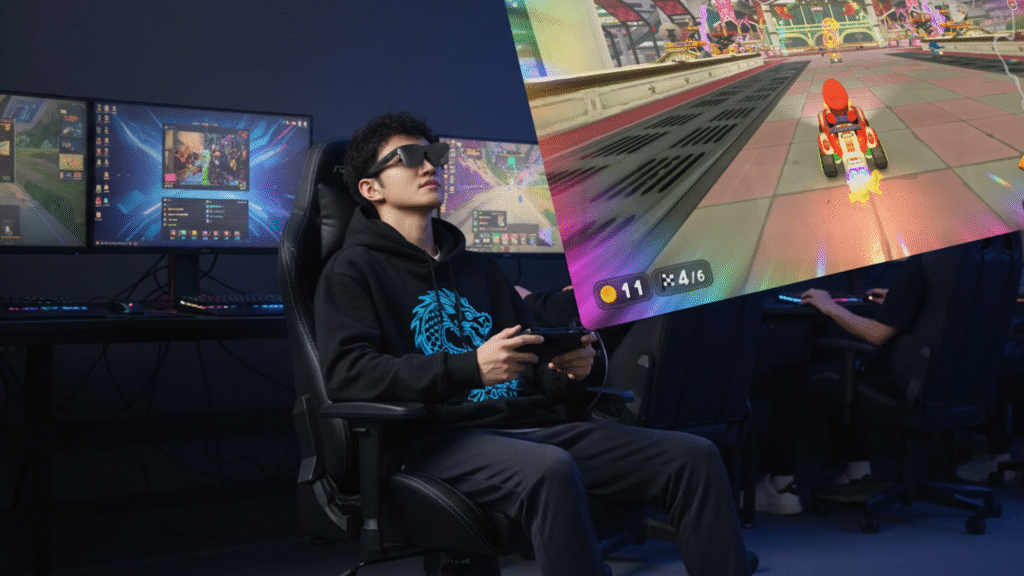
Steam Deck outputs SDR by default in many titles and scenarios, and HDR support varies by game and device/display configuration. When connected to RayNeo Air 4 Pro, these titles can gain improved contrast and color through AI conversion.
| Scenario | SDR Display | With AI Upscaling |
| Dark game scenes | Details lost in shadows | Shadow detail preserved |
| Bright explosions | Washed-out highlights | Peak brightness maintained |
| Color gradients | Visible banding | Smooth transitions |
The 120Hz refresh rate delivers responsive gameplay. First-person shooters benefit from motion clarity and improved visibility in shadowed areas.
Streaming Media Scenarios
Netflix, YouTube, and similar platforms deliver a mix of SDR and HDR, and HDR availability varies widely by title, region, plan, and device support. The AI upscaling in RayNeo Air 4 Pro allows users to watch standard content with enhanced dynamic range even when the source is SDR.
Anime and animation benefit from wider color gamut expansion. Bright, saturated colors extend into the display’s full capability. Nature documentaries show improved sky gradients and water reflections on smart glasses.
Current Limitations
Conversion quality depends on source content. Heavily compressed streams provide limited information for AI upscaling. Enhancement can’t recover detail destroyed by compression.
Extreme low-light footage may show noise amplification. Brightening shadow regions makes existing noise more visible. This affects all smart glasses attempting HDR conversion, not just RayNeo Air 4 Pro.
Power consumption likely increases during active processing. While RayNeo hasn’t specified exact power impact, AI inference draws additional current (often reflected as higher power draw from the connected source device and potential additional heat/consumption in the overall system). Users running intensive upscaling may see reduced host-device battery life.
What This Means for Wearable Displays
Real-time SDR to HDR conversion addresses a fundamental mismatch in portable entertainment. Display hardware in modern smart glasses has outpaced content delivery formats in many common use cases. AI processing bridges this gap without requiring source-side changes.
The approach enhances existing content libraries. Users access improved visuals without waiting for HDR remasters. As smart glasses evolve toward mainstream adoption, content enhancement becomes as important as display specifications. RayNeo Air 4 Pro’s implementation suggests future displays may incorporate real-time processing rather than simply rendering input signals if the experience proves consistent across diverse sources and is backed by broader third-party validation.